The Skyline G 360 Feedback Tool
The right assessment creates the right coaching.
Leadership assessments are the starting point for every Skyline G engagement — giving coaches and leaders a precise, data-backed picture of where to focus. We offer a broad portfolio of 360 feedback tools, personality assessments, emotional intelligence assessments, and developmental tools, matched to what each leader and situation actually needs.
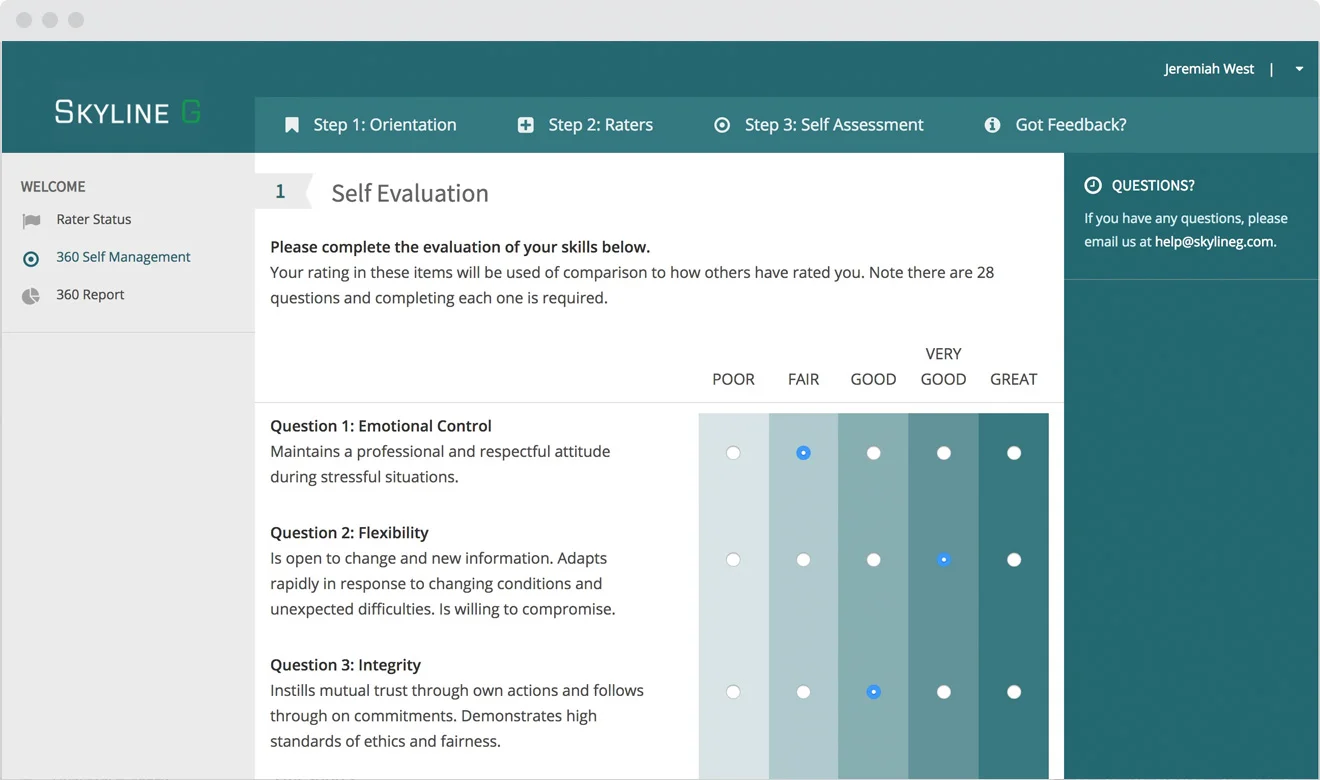
Data creates the foundation. Coaches create the change.
No assessment alone develops a leader. But the right assessment — properly selected, expertly debriefed, and woven into a coaching engagement — gives both the leader and their coach an irreplaceable head start.
At Skyline G, we do not prescribe a single tool for every situation. We match each leader, team, or organization to the assessment that will create the most actionable insight for their specific goals — then our coaches bring the human depth to interpret and apply what the data surfaces.
What no assessment can do is observe the nuance, feel the hesitation in a room, or sense the gap between what a score shows and what a leader truly needs. That is what our coaches bring.
The smarter, faster 360 feedback tool — coaches and leaders actually love it.
Four domains. 28 fundamental competencies. Normative data from thousands of leaders. The Skyline 360 is a validated 360 degree leadership assessment built from 25+ years of coaching knowledge — refined until it gives coaches exactly the right data to start every engagement with precision. Unlike off-the-shelf 360 feedback software, the Skyline 360 is built on our own methodology and designed specifically for the way our coaches work.
 10 Minutes
Unlike most 360 feedback tools, the Skyline 360 can be completed by raters in 10 minutes. Respects everyone's time. Optional comments for deeper input.
 Normative Benchmarks
Compare against thousands of leaders in our proprietary database.
 No Redundant Questions
Precise and purposeful — no asking the same thing twice.
 Customizable
Add items, modify competencies, tailor to your organization.
 Multi-Leader Rating
Rate multiple leaders at once — enabling comparison and saving time.
 30+ Page Report
Qualitative + quantitative data, debriefed live with your coach.
How the Skyline 360 is validated.
The Skyline 360 was developed in 2001 by a research team led by Gustavo Rabin, Ph.D., Founder of Skyline Group, in partnership with academic researchers from Stanford University, the University of Massachusetts, and the University of Florida. The objective was to capture what decades of existing 360 feedback research had established — and distill it into the fundamental competencies that support or derail a leadership career.
The result is an instrument grounded in both content validity (the 28 competencies are drawn from extensive theoretical and empirical leadership research) and concurrent validity (the competencies are demonstrably linked to real-world leadership effectiveness and job performance).
Rather than treating the 360 as a psychological test — where hidden traits are inferred from indirect questions — the Skyline 360 uses a behavioral descriptor approach. Each of the 28 competencies is measured through 1 to 3 clear, observable behavioral statements. The items themselves are the feedback. This is the standard for modern competency-based 360 feedback tools, and it is why traditional psychometric measures (like Cronbach's alpha for internal consistency) are not the appropriate validity benchmark — rater variability is expected and, in fact, is the signal.
To date, thousands of executives have been assessed using the Skyline 360 — producing a robust normative database that benchmarks every leader's scores against the distribution of their peers.
The outcomes our leadership assessments produce.
Our assessments are rigorous — but the measure of a leadership assessment is what it produces once it lands in a coaching engagement. Here is what Skyline G's clients report after integrating our 360 feedback tools and leadership assessments into their development programs.
The Skyline 360 has been used to assess thousands of executives across Fortune 5 companies, high-growth startups, and global enterprises. Because the assessment is debriefed live by a certified Skyline G coach — not delivered as a static report — the data gets translated into behavior change the leader and their organization can measure.
Across engagements, managers and peers providing post-program feedback consistently score participants higher on the competencies they were tasked with developing. This is the signature of an assessment that was validated, properly selected, and skillfully integrated into coaching.
Every leader is different. Every assessment should match.
We select from a broad portfolio of rigorously validated leadership assessment tools — from 360 feedback software and 360 review instruments to personality, emotional intelligence, and executive hiring assessments — matched to each leader's goals, coaching context, and what the organization most needs to understand.

Built on 25+ years of Skyline G methodology and the collective knowledge of hundreds of expert coaches. Four domains, 28 competencies, normative benchmarking against thousands of leaders, and a 30+ page report debriefed live with your coach. Smarter, faster, and more actionable than any off-the-shelf tool — and the only 360 built specifically for the way Skyline G coaches work.

A structured qualitative alternative to survey-based feedback — Skyline G coaches conduct in-depth interviews with stakeholders to surface themes, patterns, and insights that quantitative tools miss. Especially powerful for senior executives where relationship nuance and context matter as much as competency scores.

Measures both creative competencies that drive leadership effectiveness and reactive tendencies that limit it — giving leaders a full picture of their impact. The Leadership Circle Profile uniquely connects outer behaviors to inner beliefs, helping coaches and leaders understand the deeper source of leadership patterns.


Identifies a leader's primary behavioral style across four dimensions: Dominance, Influence, Steadiness, and Conscientiousness. DiSC helps leaders understand how their natural style affects communication, decision-making, and team dynamics — and how to adapt to work more effectively with others whose styles differ.

The world's most sophisticated Enneagram psychometric tool — identifying core personality patterns, unconscious motivations, and the deeper drivers of behavior. For leaders, the Enneagram is one of the most powerful tools for self-awareness, understanding blind spots, and building authentic relationships with their teams. Integrates emotional intelligence theory.

A multi-dimensional assessment measuring behavior, motivation, stress response, and social perception. The Birkman reveals the needs and expectations that drive how a leader acts under pressure — and why they sometimes show up differently than they intend to. Invaluable for leaders wanting to understand their impact and manage stress responses.

Unlike self-report EQ tools, the MSCEIT is an ability-based measure — it tests actual emotional reasoning, not just self-perception. Measures how well leaders perceive, use, understand, and manage emotions. Particularly valuable when coaching for high-stakes leadership situations where emotional judgment directly affects outcomes.
One of the most validated EQ assessments available — measuring 15 competencies across five areas: self-perception, self-expression, interpersonal skills, decision-making, and stress management. For leaders, emotional intelligence is often the differentiating factor between good and great, and the EQ-i 2.0 makes it measurable and developable.
Combines the EQ-i 2.0 with multi-rater feedback — revealing the gap between how leaders perceive their own emotional intelligence and how others experience it. Particularly powerful for leaders with high self-assessed EQ but very different feedback from their teams. The gap itself becomes the most valuable coaching focus.
Integrates emotional intelligence theory with Enneagram typology — providing a uniquely rich lens on how a leader's personality type shapes their emotional reactivity, empathy, and relational patterns. Coaches use this to create breakthrough moments of self-recognition that traditional EQ assessments alone don't always reach.

Measures the complexity of a leader's thinking and meaning-making — not just what they do, but how they think. Based on Kegan and Torbert's research, this identifies a leader's developmental stage and what it will take to grow to the next level of complexity. Especially powerful for senior executives navigating adaptive challenges no technical fix can solve.

Measures both bright-side traits that drive performance and dark-side tendencies that emerge under stress. The Hogan Derailer report is particularly valuable for executive coaching — identifying specific behaviors that have held leaders back or created negative impact, often without their awareness. A powerful tool for leaders who want the full unvarnished picture.
Goes beyond type identification to assess a leader's current level of psychological integration within their Enneagram type — revealing how developed or reactive their core patterns are, and mapping a precise developmental path toward greater health, flexibility, and leadership effectiveness.

Hiring the wrong executive is one of the most expensive mistakes an organization can make.
Rather than relying on interviews and references alone, Skyline G's Executive Talent Assessment gives hiring teams objective insight into how a leader is likely to operate in real situations — before the offer is made.
Our process integrates the Hogan personality assessments, the Birkman Method, and the MSCEIT emotional intelligence assessment with our proprietary framework — providing a comprehensive view of how a candidate will lead, make decisions, interact with others, and perform under pressure.
Identifies personality traits that predict leadership performance and highlights behavioral risks that may emerge under pressure. The Hogan reveals both the strengths a candidate will lead with and the derailers that could undermine their success — especially in high-stakes, high-pressure situations.
Measures how well candidates perceive, understand, and manage emotions — including their ability to read interpersonal dynamics, anticipate how conversations will affect others, and navigate difficult situations with judgment and empathy. Unlike self-report EQ tools, the MSCEIT is an ability-based measure — it tests actual emotional reasoning, not just self-perception.
Reveals how leaders prefer to work, what motivates them, and the conditions under which they perform at their best — as well as how they behave when those needs aren't met. Together with Hogan and MSCEIT, the Birkman completes the picture of how a candidate will think, lead, communicate, and respond to complex business challenges.

How candidates process information and approach strategic decisions — whether they are expansive thinkers, highly analytical planners, or focused on risk mitigation. Predicts how leaders will approach strategy and planning.

How a candidate moves from analysis to execution — whether they act quickly and decisively, deliberate carefully before moving forward, or risk overanalyzing decisions when speed matters most.

How candidates communicate their point of view, influence others, and respond to authority. Reveals whether leaders assert strong perspectives or collaborate and build consensus — and how they read the room.
Leadership inevitably involves disagreement. Our assessment identifies how candidates respond to conflict — whether they address issues directly, avoid confrontation, or react emotionally under pressure.
A clear, practical report that translates data into leadership implications and hiring guidance.
Our report gives hiring teams the insight they need to evaluate candidates beyond experience and interview performance — providing a deeper understanding of how the leader will actually operate in the role.
The right leadership assessment for the right leader at the right moment.
Assessments are not one-size-fits-all. Choosing the wrong tool wastes time and creates noise. Our coaches bring the experience to recommend the assessment that will create the most actionable insight for each specific leader and coaching context.
Understand the leader and context
We start by understanding the leader's role, goals, challenges, and what the organization most needs to know — before recommending any tool.
Select the right assessment
Based on coaching objectives, we select from our portfolio — or combine tools where multiple lenses will create richer insight.
Expert coach debrief
Assessment data is debriefed live by an expert Skyline G coach — bringing human judgment and nuanced observation that transforms data into direction.
Integrate into coaching
Assessment insights become the foundation for the coaching engagement — informing every session, supported by the Leadership Skills AI Coach, and tracked through ECx.
Leadership assessments & 360 feedback — answered.
Common questions about how we select, validate, and apply leadership assessments — from the Skyline 360 to the broader portfolio of tools we use in executive coaching engagements.
What is a 360 feedback tool?
A 360 feedback tool — sometimes called a 360 review or 360 degree leadership assessment — is a multi-rater instrument that collects feedback on a leader from the people who work around them: their manager, peers, direct reports, and other stakeholders. Unlike a performance review, a 360 feedback assessment is designed for development, not evaluation. The Skyline 360 is our proprietary 360 feedback tool, built on 28 validated leadership competencies and completable by raters in 10 minutes.
How is a 360 review different from a performance review?
A performance review evaluates past results against goals and usually affects compensation or promotion decisions. A 360 review is developmental — it surfaces how a leader is experienced by the people around them, identifies specific behaviors to strengthen, and feeds directly into a coaching engagement. Properly run, a 360 review is confidential, aggregated for anonymity, and never used for performance rating or disciplinary decisions.
Is the Skyline 360 feedback software validated?
Yes. The Skyline 360 was developed in 2001 by a research team led by Gustavo Rabin, Ph.D., in partnership with academic researchers from Stanford University, the University of Massachusetts, and the University of Florida. The 28 competencies and 4 domains demonstrate both content validity (grounded in extensive theoretical and empirical leadership research) and concurrent validity (linked to real-world leadership effectiveness and job performance). Thousands of executives have been assessed using the tool, producing a robust normative database for peer benchmarking.
How long does a 360 assessment take?
The Skyline 360 is designed for high rater completion. Raters can complete the core assessment in 10 minutes, with optional time for written comments. The leader receiving the feedback typically completes their self-assessment in 15–20 minutes. From launch to debrief, a full Skyline 360 cycle runs 2–3 weeks depending on rater response time.
What is the methodology behind the Skyline 360 assessment?
The Skyline 360 uses a behavioral descriptor approach. Each of the 28 leadership competencies is measured through 1–3 clear, observable behavioral statements rated on a 5-point Likert scale. This differs from psychological tests — where hidden traits are inferred from indirect questions — because the items themselves are the feedback. This is the standard methodology for modern competency-based 360 feedback tools, validated through content validity and concurrent validity rather than traditional psychometric measures like Cronbach's alpha, which are inappropriate for behavioral assessments where rater variability is expected.
Which leadership assessment is right for my situation?
It depends on what you need to learn. For stakeholder-based feedback on a leader's day-to-day behavior, a 360 feedback tool like the Skyline 360 is the right choice. For understanding personality patterns and communication style, DiSC, MBTI, or the iEQ9 Enneagram are appropriate. For emotional intelligence specifically, EQ-i 2.0 or MSCEIT. For executive hiring, Hogan Assessments identify both strengths and potential derailers. Our coaches recommend the tool — or combination of tools — that fits each leader's coaching goals and context.
How does 360 feedback software work?
Modern 360 feedback software delivers surveys digitally, aggregates rater responses anonymously, and produces a structured feedback report comparing the leader's self-scores to stakeholder scores and to normative benchmarks. The Skyline 360 feedback software adds three differentiators: a 10-minute rater experience to maximize response rates, the ability to rate multiple leaders in a single sitting, and a 30+ page report debriefed live by a certified coach — so the data actually drives behavior change rather than sitting in a PDF.